Books and study material plays a huge role in CAT preparation. Preparing for the CAT (Common Admission Test) requires more than just hard work; it demands the right study material. While online resources, mock tests, and coaching classes play an important role, nothing can replace the groundwork set by CAT preparation books.
The ideal CAT preparation books should cover every section of the exam in depth while gradually increasing the difficulty level. Whether you’re just starting your preparation or polishing your skills before the exam, these nine books can help you build a strong foundation and improve your performance.
9 Books for CAT Aspirants
1. Algebra
Algebra forms a significant portion of the CAT Quantitative Aptitude section. This book covers topics such as linear equations, quadratic equations, logarithms, inequalities, functions, progressions, and more. With concept-based explanations followed by progressively challenging questions, it helps students develop both accuracy and speed.
2. Data Interpretation – Foundation Level
If you’re new to Data Interpretation, this book is the perfect starting point. It introduces basic concepts through tables, bar graphs, pie charts, line graphs, and caselets. The gradual progression in difficulty ensures that students first understand the logic before attempting CAT-level questions.
3. Data Interpretation & Logical Reasoning – Advanced Level
Once the fundamentals are clear, this advanced book prepares students for the complex sets commonly seen in CAT. It includes high-quality DI and LR caselets that require analytical thinking, pattern recognition, and strategic decision-making—essential skills for scoring well in one of the toughest sections of the exam.
4. English Grammar
Strong grammar forms the backbone of Verbal Ability. This book covers sentence structure, parts of speech, modifiers, tenses, subject-verb agreement, punctuation, and other important grammar concepts. A solid understanding of grammar improves sentence correction, para-jumbles, and overall language accuracy.
5. Verbal Ability
The Verbal Ability section of CAT tests much more than vocabulary. This book focuses on para-jumbles, odd-one-out questions, sentence completion, paragraph summaries, and critical reasoning. Regular practice with these question types helps students improve logical interpretation and verbal reasoning skills.
6. Reading Comprehension
Reading Comprehension contributes the largest share of marks in the VARC section. This book provides passages from diverse domains such as business, philosophy, science, economics, psychology, and literature. It helps students improve reading speed, comprehension, inference-making, and question-solving strategies.
7. Arithmetic
Arithmetic is one of the highest-weightage topics in CAT Quantitative Aptitude. This book thoroughly covers percentages, profit and loss, ratio and proportion, averages, time-speed-distance, time and work, mixtures, simple and compound interest, and other frequently tested topics. Extensive practice ensures conceptual clarity and application.
8. Geometry & Number System
Geometry and Number System often challenge CAT aspirants because of their conceptual depth. This book explains properties of triangles, circles, polygons, coordinate geometry, divisibility, factors, remainders, LCM-HCF, and other important concepts through structured examples and practice questions that strengthen problem-solving ability.
9. Reasoning
Logical Reasoning is all about identifying patterns and applying logic under time pressure. This book covers arrangements, puzzles, seating arrangements, blood relations, syllogisms, coding-decoding, logical sequences, and analytical reasoning problems. Consistent practice enhances speed, accuracy, and logical thinking.
Prepare with FundaMakers' Complete CAT Book Set
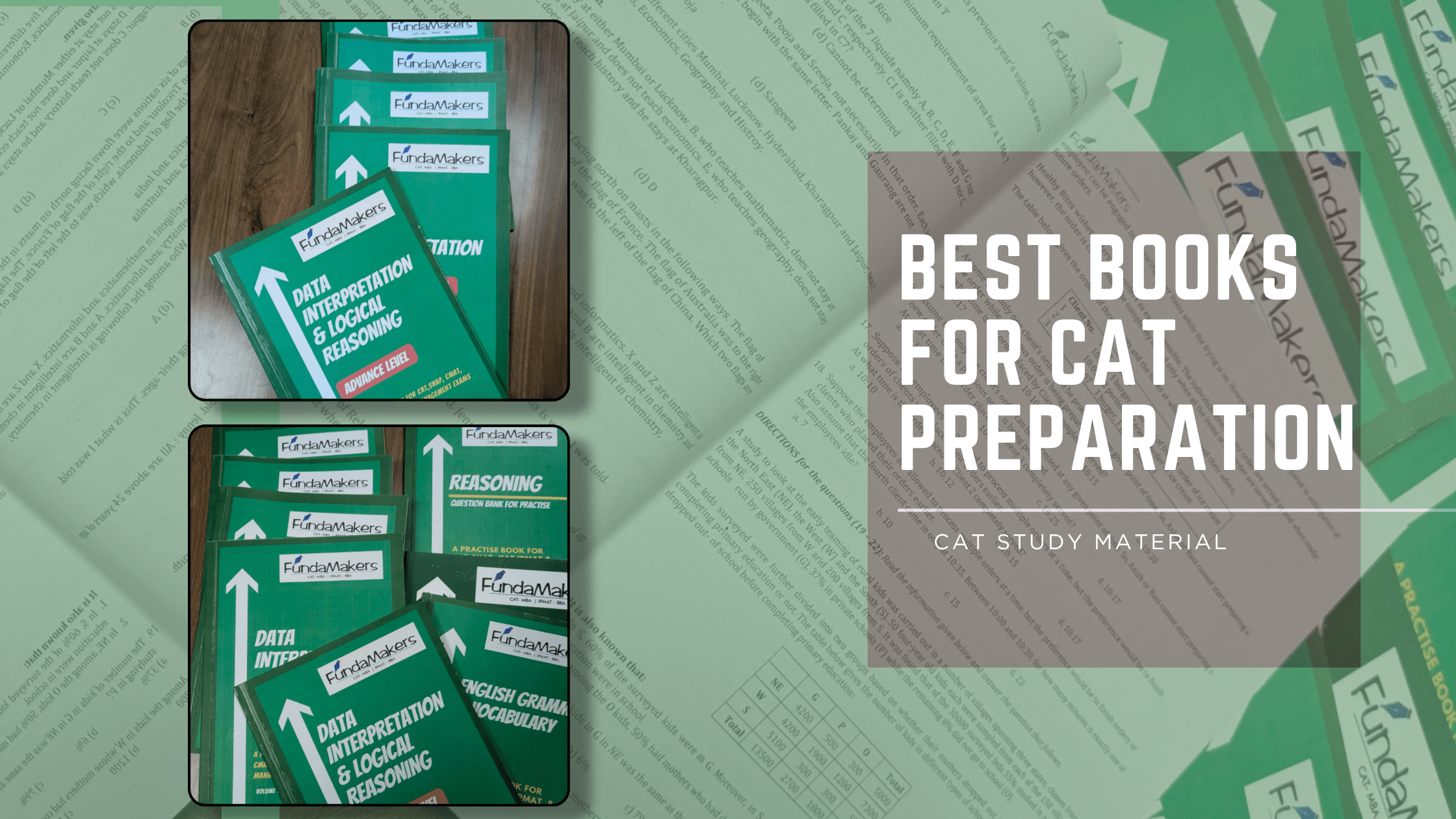
At FundaMakers, we’ve designed a comprehensive 9-book CAT preparation series that covers every major section of the CAT syllabus from Quantitative Aptitude and Data Interpretation to Logical Reasoning and Verbal Ability. Each book is structured to build concepts step by step, followed by extensive practice questions and CAT-level exercises.
Rather than searching for different books for different subjects, students get a complete, well-organized learning resource that aligns with the latest CAT exam pattern and helps them prepare with confidence.
Why the Right Books Matter
Many CAT aspirants make the mistake of collecting dozens of books from different publishers. This often leads to confusion, repetition, and an unstructured preparation strategy. Instead, studying from a carefully designed set of books that covers every important topic systematically is far more effective. Focused preparation, combined with regular mock tests and revision, delivers better results than switching between multiple resources.